 |
Northern Mine Research Society Registered Charity 326704 |
Caphouse Colliery
 |
Copyright © L Hirst and used with his kind permission |
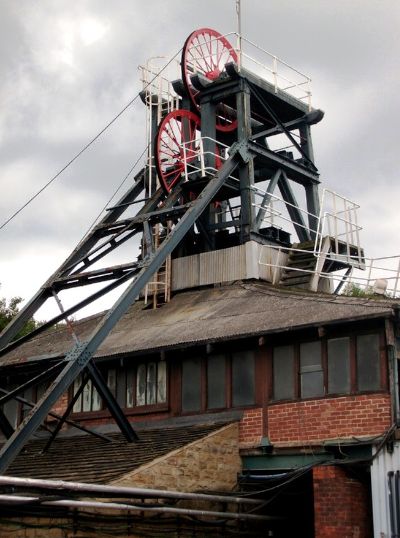
At first the pit was leased to the owners of the nearby Flockton colliery, but by the 1850s Caphouse Pit was being worked as part of Denby Grange colliery by Sir J.L.L. Kaye. On his death, Miss Emma Lister-Kaye took over in 1871. Her initials can be seen on a date stone (ELK 1875) on the winding engine house. The twin-cylinder steam winding engine, by Davy Bros., is still in situ. It was bought from a woollen mill and was used regularly until 1974, and occasionally until 1981.
The mine was run by the executors of E. Lister-Kaye, from 1905 (when she died) until 1921 when it was taken over by Denby Grange Collieries Ltd.
Greaves was also on the boards of: Airedale Collieries Ltd, Manor Haigh Moor Colliery Ltd, Terry, Greaves & Co. Ltd, Henry Briggs, Son & Co. Ltd and Robert Holliday & Sons Ltd which all ran collieries around Wakefield.
Chairman/MD Percy Christian Greaves Directors: Henry Bower Tatton
Cecil Lister Kaye
Sir John Lister Kaye
From 1943 to 1946, however, Lockwood & Elliott, the owners of Shuttle Eye colliery (3.3 km to west on A642) ran Caphouse. Then it was nationalised. Caphouse was a fairly small pit, with an average of 177 men working underground, and 46 on the surface for most of its time under the NCB. Output was restricted by its narrow (11 feet diameter) shaft which limited the winding capacity. In 1974, therefore, a conveyor drift was opened to bring coal to the surface.
During 1980, Caphouse was merged with Denby Grange to form Caphouse-Denby Grange. Then, with its available coal nearing exhaustion, Caphouse was scheduled to close in late October 1985, but first, in September 1985, it was merged with Bullcliffe Wood and the new Calder Drift, and the whole renamed Denby Grange. Caphouse did close in October 1985, but the original Denby Grange (Prince of Wales Pit), at Netherton, worked until August 16th 1991.
Seams worked: New Hards 1903-1913 Wheatley Lime 1903-1962 Beeston 1941-1975, 1981-1985 Top Beeston 1976-1980
Ownership 1854-1875 Sir J.L.L. Kaye, Bart 1876-1904 Miss E. Lister-Kaye 1905-1921 Exors of E. Lister-Kaye 1922-1942 Denby Grange Collieries Ltd 1943-1946 Lockwood & Elliott 1947-1985 National Coal Board 1988-1994 Yorkshire Mining Museum 1995- National Coal Mining Museum for England
Caphouse was to have a new life, however, and in 1988 it reopened as the Yorkshire Mining Museum. Following the closure of Chatterley Whitfield colliery museum in 1991, Caphouse became the National Coal Mining Museum for England from 1995 onwards.
Hope Pit, at the eastern end of the museum site, was sunk between 1827 and 1829 under the supervision of John Blenkinsop, the mining engineer, who was based at Middleton Colliery in Leeds. It is now used to pump highly ochrous water, to prevent it surfacing in other places, and treat it. Another survival, in the same area, is the Cornish pumping engine house on Inman's Shaft, which dates from around 1841. A large modern building, the Hope Store, houses some of the museum's large mining machinery and vehicles. These include underground locomotives, BJD coal cutters, a 1967 NCB Morris ambulance used at Markham Main Colliery, South Yorkshire, and a seventeen-tonne Dosco Roadheader.
The National Museum is well worth a visit. You can either go underground or examine the surface remains and many displays. The library is an excellent centre for researching all aspects of coal mining. www.ncm.org.uk
If you are in Scotland or Wales, why not visit:
- Lady Victoria Colliery, Newtongrange, Midlothian, EH22 4QN - www.nationalminingmuseum.com
- Big Pit National Coal Museum, Blaenafon, Torfaen, NP4 9XP - www.museumwales.ac.uk/bigpit